Gaming Composition Notebook Keywords for Amazon KDP Success
If you're a creator or publisher on Amazon's Kindle Direct Publishing platform, you've likely faced the frustrating reality of low visibility and stagnant sales. You may have invested time in crafting a beautifully designed gaming composition notebook, only to find it languishing on page ten of Amazon's search results, unseen by potential buyers. The common misconception is that a great cover and interior design alone will drive sales. In today's crowded marketplace, that’s rarely enough. The crucial, often overlooked element is strategic keyword research and implementation.
Why Keywords Are Your Publishing Foundation
Keywords are the bridge between your product and your customer. When someone searches for "gaming journal," "video game notebook," or "composition book for gamers," they are expressing a specific need. If your gaming composition notebook is not optimized with these exact terms, it remains invisible. This is where dedicated Gaming Composition Notebook Keywords research becomes indispensable. It's not about guessing what might work; it's about using data to understand what buyers are actually searching for.
The challenge on Amazon KDP is twofold: you need high-demand keywords, but you also need to find opportunities with manageable competition. Targeting only the most popular terms means competing with hundreds of other listings, making it difficult to rank. Conversely, targeting obscure terms with no search volume means no one will find you. The ideal strategy involves identifying keywords with a healthy balance of search volume and lower competition—the sweet spot for new and existing publications.
Transforming Data into a Practical Publishing Strategy
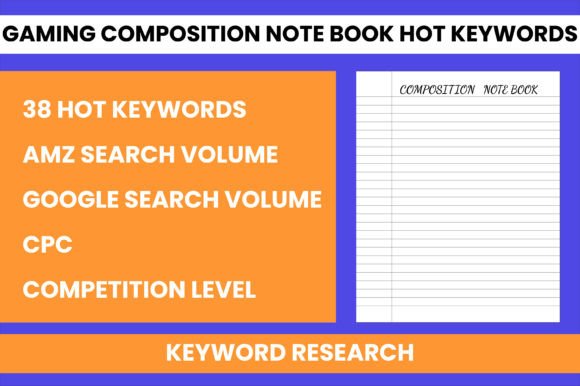
A robust keywords file, such as one offering analysis on Gaming Composition Notebook Keywords, shifts your approach from speculative to strategic. Imagine having an Excel sheet that breaks down 38 specific keyword phrases. For each term, you see the estimated monthly search volume directly on Amazon (AMZ Search Volume), which tells you how often potential customers use that phrase on the platform. You also see Google Search Volume, indicating broader interest, and CPC (Cost Per Click), which hints at commercial value and competition in the advertising space.
Most critically, a competition level assessment helps you gauge how many other publications are already targeting that keyword on KDP. This data allows you to validate your choices. Instead of publishing a notebook based on a hunch about "RPG character logs," you can confirm if there's sufficient demand and whether the niche is saturated. This analysis helps you pivot from creating generic products to filling specific, validated gaps in the market.
From Zero Sales to Discoverable Products
For the professional, entrepreneur, or hobbyist who has published multiple books with zero sales, this data-driven approach offers a clear path forward. The practical benefit is efficiency. You save countless hours of trial and error, and you direct your creative efforts—your design skills for that gaming composition notebook—towards projects that have a proven route to visibility. Your good design now works in tandem with smart market positioning.
Consider a practical use case: you're planning a series of themed gaming notebooks. Without data, you might choose themes randomly—one for Minecraft, one for general gaming, one for streaming. With keyword analysis, you can discover that "Minecraft journal for kids" has high Amazon search volume but also high competition, while "streaming content planner notebook" has moderate volume and very low competition. This insight allows you to prioritize. You can confidently develop the streaming planner, knowing you have a stronger chance of ranking on the first page of search results, thereby increasing your chances of selling that book.
Who Benefits Most from Keyword Analysis?
This resource is particularly valuable for a distinct audience. Amazon KDP publishers who feel stuck, despite a portfolio of books, will find it a tool for diagnosis and direction. Content creators and bloggers expanding into physical products can use it to ensure their first publications are market-ready. Educators or freelancers creating niche notebooks for communities can validate their ideas before investing in design and listing. Even small business owners using KDP to produce branded merchandise can employ this analysis to ensure their products reach their target audience.
The core benefit is problem-solving. It directly addresses the primary problem of poor discoverability on Amazon. By aligning your gaming composition notebook's title, subtitle, and backend keywords with phrases that have been data-validated, you strengthen its communication with Amazon's search algorithm. This isn't a guarantee of sales—product quality, price, and reviews still matter profoundly—but it is a fundamental step in ensuring your book can even be found by those who would want it.
Implementing Keywords for Maximum Effect
Once you have a list of profitable Gaming Composition Notebook Keywords, implementation is key. Amazon allows for keywords in multiple places: the product title, the subtitle, and the backend keyword field (which is not visible to customers but is crucial for search). Your strongest, most relevant keywords should be integrated naturally into the title and subtitle. For example, a title could be "Video Game Design Journal: A Gaming Composition Notebook for Developers & Fans." This incorporates key phrases while remaining readable and appealing to a human buyer.
Thoughtful observations matter here. Avoid keyword stuffing, which makes titles look robotic and can potentially harm your listing. The goal is to use the data to inform human-centric, compelling product copy. Furthermore, this analysis can help you find new niches. Seeing a keyword like "esports training log" with decent metrics might inspire a whole new notebook product you hadn't considered, expanding your catalog intelligently.
Limitations and Considerations for a Balanced View
While a keywords file provides a powerful advantage, it's important to understand its role as a component of a larger strategy. The data is a snapshot—search volumes and competition can change over time. It is a starting point for research, not an eternal guarantee. Your own success will also depend on factors outside the keywords, such as the actual design and usability of your gaming composition notebook, your pricing strategy, and accumulating positive reviews.
Users should also compare options. Not all keyword research resources offer the same depth. A file providing Amazon-specific volume, Google volume, CPC, and a competition level assessment offers a more holistic view than a simple list of phrases. When evaluating such a tool, consider how recent the data is and whether the competition metric is tailored to Amazon KDP's book marketplace, rather than general e-commerce.
Ultimately, the value lies in moving from uncertainty to informed action. For the creator worried about their published books, this shifts the focus from "why aren't my books selling?" to "how can I optimize my next publication and my existing listings for discoverability?" It supports the goal of building a sustainable publishing venture on KDP by grounding creative decisions in market reality. By marrying your good design with low competition, high-intent keywords, you create a product that is not only attractive but also strategically positioned to be found, which is the first and most critical step toward achieving sales.