Beyond the Cover: How Data-Driven Keywords Transform Amazon KDP Publishing
The landscape of self-publishing on Amazon KDP is often painted as a realm of creative freedom. Yet, for many professionals, creators, and entrepreneurs, it can feel like a marketplace of silent shelves. You've invested in quality content and compelling design, publishing numerous books, only to find sales stagnating at zero. This common frustration underscores a critical, often overlooked truth: in the digital marketplace, a good design alone is not a vehicle for discovery. Visibility is the engine, and that engine is fueled by strategic keyword research. Enter the concept of Composition Notebook Video Gaming Keywords—a specific, data-informed approach that exemplifies the modern necessity for niche, low-competition search terms to propel books to the forefront of Amazon search results.
Decoding Composition N.B Video Gaming Keywords
At its core, Composition N.B Video Gaming Keywords represents a micro-niche within the vast Amazon ecosystem. It merges two distinct consumer interests: the practical, physical need for composition notebooks and the passionate, lifestyle-driven world of video gaming. This isn't a random pairing. It identifies a specific user intent—a gamer, student, or enthusiast looking for a notebook tailored to their gaming hobbies, perhaps for game logs, strategy notes, or character development. This keyword cluster moves beyond generic terms like "notebook" or "gaming journal" into a more precise search phrase that carries lower competition and higher relevance. For a publisher, targeting such a keyword means creating a product that answers a very specific query, thereby dramatically increasing its chances of ranking on the first page of Amazon search, where the majority of sales occur.
The Shift From Creative to Strategic Publishing
The attention paid to specific keyword sets like these signals a broader evolution in self-publishing. The industry is maturing from a purely creative endeavor into a data-driven business operation. Marketers and savvy freelancers now approach KDP not just as a platform for expression, but as a search-driven marketplace governed by algorithms. This reflects larger trends in consumer behavior: audiences have grown accustomed to using precise, long-tail search phrases to find exactly what they need, bypassing generic offerings. The changing expectation is for products to be discoverable. Authors and publishers must now integrate keyword validation into their workflow just as rigorously as they do editorial and design stages.
Why Data Analysis Is the New Editorial Board
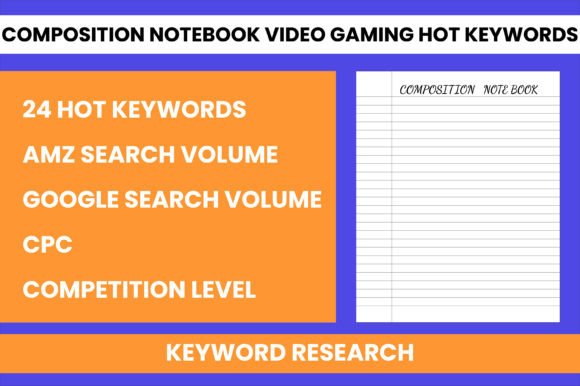
The promise of a file containing an Excel sheet with full keyword data analysis—listing 24 profitable keywords, AMZ and Google search volume, CPC, and competition level—is not merely a list of suggestions. It is a validation toolkit. This analytical approach aligns perfectly with the needs of modern entrepreneurs who must mitigate risk and maximize ROI in every project.
- AMZ Search Volume: Reveals the direct demand within the Amazon marketplace, the most critical metric for a KDP publisher.
- Google Search Volume: Indicates broader interest and potential for external marketing or cross-platform visibility.
- CPC (Cost Per Click): Suggests the commercial value and competitiveness of the topic in the wider digital advertising space.
- Competition Level: The cornerstone metric. Low competition within Amazon for a keyword like Composition N.B Video Gaming Keywords means a clear path to ranking, unlike saturated niches where even excellent books get buried.
This data doesn't just suggest a topic; it validates a business opportunity. It helps identify new niches and confirms whether an idea has a viable audience before a single page is written or designed.
Connecting to Larger Developments in Technology and Commerce
This methodology is a direct application of the big-data analytics that now permeate every sector. The ability to parse search volume and competition is akin to a small business conducting market research before launching a product. In technology, it mirrors the shift towards SEO and semantic search understanding, where context and specific user intent triumph over vague keywords. For the lifestyle and creative communities, it represents a professionalization of passion—enabling gamers, artists, or hobbyists to not only create content about their interests but to strategically deliver it to a waiting, searching audience.
Practical Applications: From Keyword to Published Book
How does this translate into practice? Consider the provided keyword example. A publisher receives the data confirming "Composition Notebook Video Gaming Keywords" as a low-competition, high-intent search phrase. The next steps are inherently strategic:
- Product Conceptualization: Develop a composition notebook specifically designed for gamers—with sections for game reviews, achievement trackers, or squad member details.
- Title and Subtitle Optimization: Incorporate the exact keyword phrase naturally into the book's title and Amazon subtitle to maximize algorithmic relevance.
- Description and Backend Keywords: Use the keyword and its variations throughout the product description and in Amazon's backend keyword fields, weaving them into natural, helpful content that informs the buyer.
- Cover Design Synergy: While design alone isn't enough, the cover must visually communicate the keyword's promise—clearly showing a notebook with gaming-themed graphics.
This holistic approach ensures the product aligns with the discovered search intent at every touchpoint, creating a cohesive and discoverable listing.
The Forward-Looking Path for KDP Professionals
The integration of deep keyword analysis is not a speculative trend; it is the emerging standard for sustainable KDP success. For professionals and enthusiasts alike, the workflow now expands to include:
- Regular niche exploration using similar data-analysis techniques.
- Validation of every book concept against quantifiable search metrics.
- A content strategy that is driven by user search intent, not just personal interest.
This transforms publishing from a hopeful act into a calculated business activity. The ultimate insight is that Amazon KDP, like any other digital platform, is a search engine first. The books that answer specific, underserved queries—like those found through analyzing Composition Notebook Video Gaming Keywords—are the ones that climb to page one. They fulfill a clear consumer need, and in doing so, they convert visibility into sales, moving beyond the silence of zero sells to the activity of a thriving publishing enterprise.
The provided keyword data file symbolizes this shift. It is a tool for empowerment, offering creators the evidence needed to navigate the marketplace with confidence. When satisfaction is prioritized, as noted in the original message, it is achieved not just by a list of words, but by the tangible results that come from applying a data-informed, strategic lens to the art of publishing. The future of KDP belongs to those who master this union of creativity and analytics.