Weekend Forecast Gaming T-Shirt: From Digital Design to Perfect Print
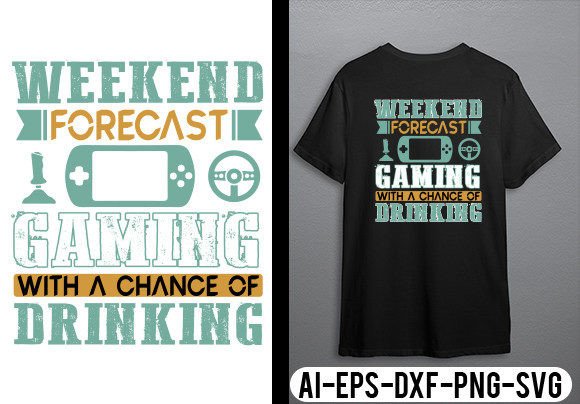
If you've ever searched for a fresh, witty design for your gaming merchandise, you've likely come across something like the Weekend Forecast Gaming T-Shirt. This popular concept cleverly blends the anticipation of a weekend with the universal gaming experience, often depicting "100% chance of gaming" in a classic weather report style. Its appeal is broad: gamers love it for its relatable humor, while creators and small business owners see a ready-to-print design with clear commercial potential. But the journey from downloading the files to holding a perfect printed shirt is where many stumble.
The Digital Files: Understanding What You Actually Need
When you purchase the Weekend Forecast Gaming T-Shirt as a digital download, you typically receive a bundle of files: AI, EPS, PNG, SVG, and DXF. The description often highlights that files are "expanded" and won't cause trouble to open, at a high resolution of 4500x5400 pixels and 300 DPI. This sounds perfect, but the first common oversight is not understanding the role of each format.
Many beginners download the bundle, pick the PNG because it's familiar, and send it straight to a print service. This is a mistake. While the PNG at 300 DPI is excellent for some uses, professional printing, especially for garments, often requires vector files. The AI and EPS files are typically the master vector artwork, meaning they can be scaled to any size—from a small logo on a hat to a massive banner—without losing a single pixel of quality. The SVG is a web-friendly vector format, great for digital use or certain cutting machines. The DXF is usually for CNC or engraving applications. Using the wrong file type can lead to a blurry, pixelated print on your shirt, disappointing your customers or ruining a personal project.
Better approach: Before you even download, know your end use. For direct-to-garment or screen printing, provide the printer with the vector EPS or AI file. For uploading to a print-on-demand platform like Shopify or Printful, check their specifications—they often accept high-res PNGs, but vectors are safer for future scaling. Always communicate with your printer to confirm which file format they prefer.
High Resolution Isn't a Magic Shield
The specs "4500x5400 pixel . 300 DPI" are impressive and rightly advertised to assure quality. A common misunderstanding, however, is treating these numbers as a universal guarantee. High resolution is crucial, but it's not the only factor in print quality. The design's composition matters immensely.
For instance, if the Weekend Forecast Gaming T-Shirt design uses very thin, delicate fonts for the "forecast" details, even at 300 DPI, those fine lines might not translate well to certain fabric types or printing techniques like heat transfer. Another overlooked detail is color mode. Professional print requires CMYK color separation for most fabric printing, while your digital files are often in RGB. If you send an RGB PNG to a CMYK-based printer without conversion, the vibrant colors on your screen—especially any bright blues or reds in that weather graphic—can look muted and dull on the shirt.
Practical advice: Open the AI or EPS file in a program like Adobe Illustrator. Check the actual line weights and the color palette. If you're not skilled in graphic software, ask your print service to do a pre-print proof and specify that you want a color match proof. This small step can save you from a batch of shirts with washed-out colors.
Expanded Files: The Hidden Time-Saver
The note that "files are expanded" is a crucial but often glossed-over detail. In digital design, "expanded" usually means that any text in the artwork has been converted to outlines (paths). This is vital. If the designer used a specific font and left it as live text, you would need that exact font installed on your computer to open and edit the file correctly. Without it, the text could default to a different font, breaking the design.
By providing expanded files, the creator of the Weekend Forecast Gaming T-Shirt has eliminated this problem. You won't face a missing font warning, and any print shop can open the file without issue. Yet, a mistake occurs when a buyer tries to edit the text. Since it's outlined, you cannot simply type new words like "Weekend Forecast" in a different language. You need vector editing skills to modify it.
What to check: If you need customization, assess your own graphic editing capabilities before purchase. If you lack them, look for designers who offer customization services or consider learning basic vector manipulation. Trying to edit an outlined file with a raster tool like Photoshop will degrade the quality.
From Download to Application: Avoiding Platform Pitfalls
For entrepreneurs using print-on-demand platforms, the process is streamlined but not foolproof. A typical error is uploading the high-res PNG of the Weekend Forecast Gaming T-Shirt and immediately listing it for sale without a test print. Different platforms and their partnered printers have varying output results. A design might look crisp on one provider's cotton tee but blurry on another's polyester blend.
Furthermore, the placement is automatic on many sites. The design might be centered, but is that the best look for this particular graphic? Perhaps the "weather report" layout would look more balanced slightly higher on the chest. Not checking these details can lead to a generic, less impactful final product.
Realistic example: A blogger selling merch for their gaming community uploads the design and sells fifty shirts. They receive complaints that the print feels stiff (due to the wrong transfer method for the fabric used) or that the graphic is too low. They now face refunds and reputational damage.
Better choice: Always, always order a sample. Wear it, wash it, and check the durability. Adjust the placement on the platform's designer tool if possible. This upfront cost is an investment in customer satisfaction and avoids the far greater cost of a failed product launch.
The True Value Beyond the Initial Download
Thinking of the Weekend Forecast Gaming T-Shirt files only as a one-time shirt design is a limiting view. The true value of a versatile, high-quality digital download bundle lies in its adaptability. The same SVG file can be used for a website icon for your gaming blog. The DXF might allow you to engrave the design on a gaming controller case. The PNG can become a featured image in a related article.
A common oversight is not leveraging these rights. The license usually allows for multiple print purposes, but many buyers use it for a single product and shelve the files. This underutilizes your investment.
Constructive advice: Map out a mini-product line. Could the design work on a hoodie, a mug, or a poster? Use the appropriate file format for each medium. By thinking in terms of an asset library, you transform a single purchase into a cohesive branding opportunity for your gaming-related venture.
Ultimately, the Weekend Forecast Gaming T-Shirt digital files represent a powerful start. By understanding the specifics of each format, verifying color and application for your intended use, insisting on a test print, and planning for multi-use, you move from simply hoping for a good result to ensuring a professional, high-quality outcome that truly resonates with the gaming community.